
International Worker's Memorial Day 2026 Liverpool Event
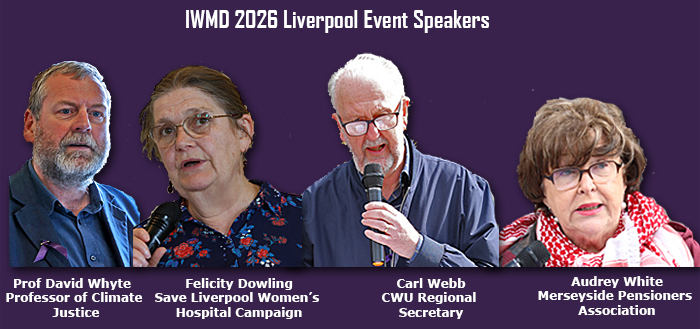
* Speakers: Audrey White, Carl Webb, David Whyte, Felicity Dowling*
The International Worker's Memorial Day is an annual event taking place in countries across the world, from the UK to Europe, to Africa and Asia, to Australia and New Zealand, to Canada and USA, to South America.
The longstanding message of Workers’ Memorial Day — “Remember the Dead. Fight for the Living.” — reminds us that behind every statistic is a worker whose life has been permanently changed or cut short by unsafe work, including unsafe systems of work that damage mental health.
Every year on 28th April, Trade Unions, Workers, and labour organisations come together to commemorate those who have lost their lives due to lazy and uncaring employers whose criminal negligence, leads to injury, avoidable accidents, and in some severe incidents, the death of workers.
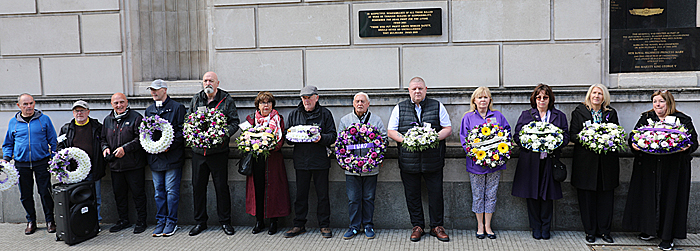
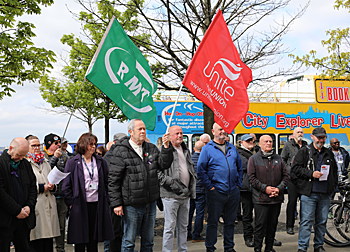
The day's event in Liverpool took place in 3 parts - gathering together with the Socialist Singers outside The Port Of Liverpool Building main entrance facing the Pier Head, to hear two guest speakers. Then followed by the laying of wreaths in front of the Commemorative plaques honouring the Mersey Tunnel workers who lost their lives building Merseyside's first major road tunnel under the River Mersey; and the adjacent plaque honouring the life of Tony Mulhearn, a worker who was passionate about worker's health & Safety. His words in 2019 at that year's IWMD event are inscribed upon the plaque which was installed on the St Georges Dock building on The Strand:

Finally, to the Piper's Lament, following a one minute of silence; those assembled followed the piper to the afternoon venue with refreshments and two more speakers and stalls by two of the solicitor's firms who support the event each year.
Here we report on the day's events in photos and video:
Introduction by John Flanagan and Roger Phillips
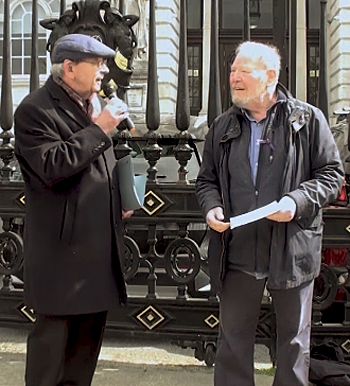
John began by detailing to those gathered at the Pier Head entrance to the Port of Liverpool Building, the agenda for the day, and introducing the IWMD 2026 event host; Roger Phillips, ex-BBC Radio journalist and presenter of a mid-day show which was extremely popular on Merseyside. Rodger has been a long-term keen supporter of IWMD over many years.
Roger then introduced Merseyside's popular group of choristers: the Socialist Singers:
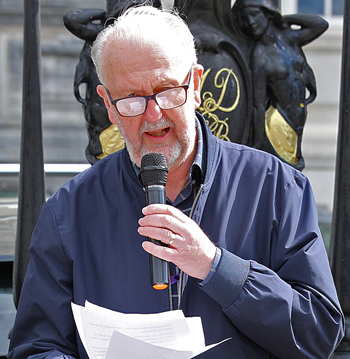
Roger then introduced the event's first speaker, the CWU's Regional Secretary, Carl Webb.
Carl began by saying:
"Every year on this day, International Workers Memorial Day is observed across the world to remember workers who have lost their lives, been injured or become ill as a direct result of unsafe or unhealthy working conditions. Globally, more than 2.78 million workers die each year at work.
Additionally, there are approximately 374 million non-fatal work-related injuries each year. Add to these the over 160 million who develop illnesses from unsafe, unhealthy or unsustainable work and workplaces."
Carl continued:
"International Workers Memorial Day serves as a reminder of the work that we need to do to make sure that health and safety legislation is both strengthened and even just adhered to, and to raise awareness about how workers can protect themselves in their workplaces.
 The struggle for health and safety regulations was long fought and still each year workers suffer approximately 270 million accidents and one worker dies every 15 seconds worldwide. This is why it's so important to both remember and continue to fight for better protections in the workplace."
Reminding everyone that trade unions every year fight to protect workers by negotiating to make work safe and to lobby for compensation for the families who have lost their lives. Carl said:
"It is a stark fact that every year more people die at work than they do in wars."
Carl concluded:
" Today we pause, we reflect and honour all those who have been lost due to unsafe work. This day serves as a solemn reminder that behind every statistic is a story, a name, a family, a worker, community forever changed by a preventable workplace tragedy. Solidarity to all."
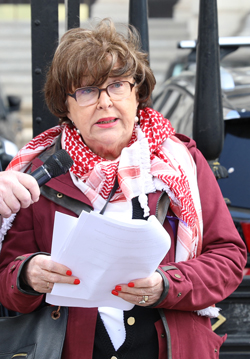
The next speaker was from the Merseyside Pensioners Association, Audrey White:
"I don't know about you, but most of us in the MPAA were brought up hearing the idea that hard work never killed anyone. When in actual fact, it's got no basis in the truth. We were also told that a bonfire of the regulations wouldn't kill anyone, and there was absolutely no truth in that as well. And of course, we've been told the Labour Party would protect workers if only they could gain power.
 And we know what a heap of that is as well. Absolute garbage. We have less protection now. We only have to look at Britain's Health and Safety Executive and the unions still being disempowered.
But the health and safety executive is the body charged with preventing work-related death injury and health ill health across industries it's an enforcement agency it's a regulator and it can prosecute for non-compliance so let's have a look at how seriously this hsc is taken not the workers
But their government and the budgets, their budget has been cut by 45% over the years, meaning it's less able to protect workers.
Their workload has increased and their wages have been cut by 20 to 25% and scandalously inspections have been cut by almost a half.
Imagine working there, just the workers working in HSE knowing that inspections are slashed while your responsibilities grow knowing that because you can't do your job properly the bosses will ignore safety regulations, and that workers will be injured and that workers will die.
So HSE themselves working under that kind of pressure is a killer in itself. So who are those workers who die every year in Britain? They're mostly men over 60 years of age and they're mostly self-employed.
All those figures tell their own story of workers pushed into unsafe conditions, forced to take risks just to keep a roof over their heads. But even that figure doesn't tell the truth.
Because all the way there's less than 200 workers die in immediate incidents each year, we should never lose sight of the 13,000 workers annually in the UK whose deaths are linked to past workplace exposures.
And internationally, as the previous Comrade was saying, the picture is even worse, with work-related deaths approaching 3 million globally and 4 million non-fatal injuries.
So when we hear that hard work never killed anyone, just look to Japan where they have a word for it. It's called 'karoshi' and it means 'death by overwork'. We don't even have a word for it. So how many of these deaths are even recorded? Let's face it, across the world workers are forced to work long hours in unsafe, understaffed, high pressure environments.
And that pressure brings many lives to a miserable and early end.
 Sexual harassment, bullying and so on in the workplace. But it's the greed of employers putting profit before safety that drives a culture where regulations exist on paper, which is all very well, but they are ignored in practice. They are only taken into consideration when tragedy strikes. And even then, too often, nothing fundamentally changes. And today that reality, I mean, I think this is interesting, even though I did write it myself, that into new kinds of workplaces, including the digital world,
There are thousands and thousands of low paid workers across the globe who are employed to moderate online content. We might disagree with some of it being moderated politically, but to be honest with you, the hidden workforce the words behind the platforms that we all use are exposed day after day to the worst that humanity has to offer. Child abuse, violence, exploitation and so on. But yet many of these workers, and the mostly young, the mostly low paid, are given little
No mental or no psychological support and no proper access to counselling and no long term protection. These are workers absorbing trauma so that others don't have to see it. Workers whose mental health is treated as expendable. Workers whose injuries are invisible but no less real. This is workplace harm. This is occupational injury.
And this is happening on an industrial scale more and more. Just because the workplace is digital, it does not mean that the damage is not real. And just because the scars are unseen, it does not mean that they don't last a lifetime."
Audrey continued by giving a recent example of an avoidable catastrophy which occurred in the US 24th March 2026:
"When safety systems fail, and when staffing is cut, and when recommendations are ignored, the consequences are devastating. Take the recent tragedy we all know about at LaGuardia Airport in New York recently. Who thought it was acceptable for just two aircraft controllers to manage the ground and flight movements on a busy night?
Who ignored the recommendations only last year that 3,000 more controllers were needed?
Who failed to implement basic safety measures? Which was the recommendation to have transponders. I mean it's basic isn't it?
Transponders on the ground, on the ground vehicles. And what was the result of that? A plane was cleared to land and collided with a fire truck. Two young pilots died. But this was not an accident in the way you think of an accident.
if I can just try not to be paid, it was the predictable outcome of understaffing, underinvestment and ignored safety warnings. And while the investigations take months, while reports will be written, and blame aside, we should also think about that other worker,
 The air traffic controller, a worker placed in an impossible position, a worker who will carry that moment for the rest of his life, a worker who was already blamed, it was already blamed within hours of the tragedy. And this is what happens when systems fail. The worker pays the price in life, in health, as well as in guilt.
And this is not the first time safety recommendations are ignored and it won't be the last. Because this is not an isolated incident, it's a pattern.
A pattern that workers everywhere know all too well. And that is why we stand here and we're standing here now. We stand here to remember the family members we have lost. I always remember my mum and I always remember Tony Mulhare. And we stand for the friends we have lost and the comrades we have lost.
And we remember too the millions of workers across the world whose lives have been sacrificed not by accident but by a system that often treats them as expendable. We say that their lives mattered and we say that their work mattered and we refuse to let them be forgotten. And that is why we remember the dead.
And that is why we fight mostly in the trade union movement. We fight like hell for the living."
Wreath Laying One Minute Silence And Piper's Lament
Following Audrey's speech, the event moved round to the memorials to those who died working on the Mersey Tunnel built for the road network under the River Mersey to Birkenhead which was one of the first major pieces of infrastructure built in Liverpool.
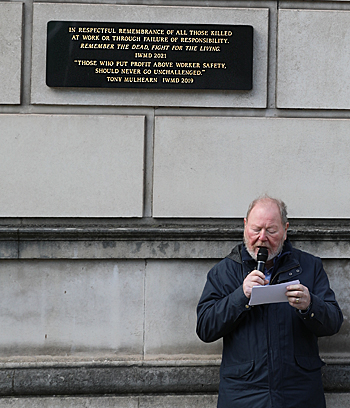 Alongside this monument, is a plaque dedicated to Tony Mulhearn, a trade unionist who through all his working life for the health and safety of workers on Merseyside. The plaque, pictured above top of this page, is engraved with his words at the last IWMD event he attended before his passing from Interstitial Pulmonary Fibrosis (IPF), contracted by him following exposure to asbestos.
Here wreaths were laid, followed by a lone piper's lament and a minute silence in memory of those killed by their work.
Roger Phillips gave a powerful and heartfelt speech to all those who had lost a loved due to work, the trade union members, law firms representatives, and general public gathered in front of the memorials:
"What people have said is today it is a sad day but it's also a really important day and we've been well reminded how many people have died and are dying because of the greed of basically because the money comes before safety it seems to be very good many many people do not die in accidents these are not accidents they're because an employer decided to put profit before safety. Simple as that. Make the money, who cares about the workers?
Carl mentioned some really important facts, I've got one or two more. The long-term hazard, it was mentioned, 13,000 deaths every year linked to past exposures like occupational lung disease and cancer, asbestos, silica,.
Safety campaigners estimate that figure is much larger. It's more like 50,000 deaths every year.
And it continues, it carries on, and we've got to stop it somehow or other, or at least reduce it. Around the world it's the union movement, as Audrey mentioned, that's doing all the work in trying to stop all this kind of thing, trying to stop workers losing their lives because of their jobs. So we aren't here simply to remember the dead.
To fight for the living, that's what it's about. We've got to defend workers' rights to a safe job. And while we remember all those who died because of their work, it is vital to continue, as the unions do, to fight against work-related stress and unrelenting workloads. The example of La Guardia is great. It's just one example. There are many, many examples.
So today is about honouring and celebrating the effort put in by workers across the world. It's about revisiting the rights of workers and preventing them from getting exploited. Each worker deserves respect and the right to lead a dignified life. And this day is to salute them for all their contributions in every different sector.
Because a worker Off the floor is third class. A worker is a creator, a valuable, important asset for any country. Without workers, countries wouldn't exist. I'm here to show my gratitude and admiration for all the workers in every sector. My job is a very easy job and very, very few people lose their lives because of it.
So I look with admiration at those workers who do these incredibly difficult jobs.
So let's all honour the nation's workers, past and present. For without them, this country and every country's growth and progress would not be complete. It's a great day today. We've got to enjoy the day. It's an important day.
And I just draw your attention to Tony Mulhern's words which are just above me here. Tony Mulhern was a great fighter. I admire Tony beyond measure. Because he never ever, unlike others, he never forgot what he was here for. He fought and fought and fought."
Afternoon Event - Refreshments, Speeches And Stalls
As in previous years, the thrid part of the IWMD 2026 Liverpool event took place at The Racquets Club Hotel in Chapel Street. A 5-minute walk following the Piper, was met with John Flanagan welcoming attendees and introducing the final event of the day.
Click the pic to learn about
the specific law firm
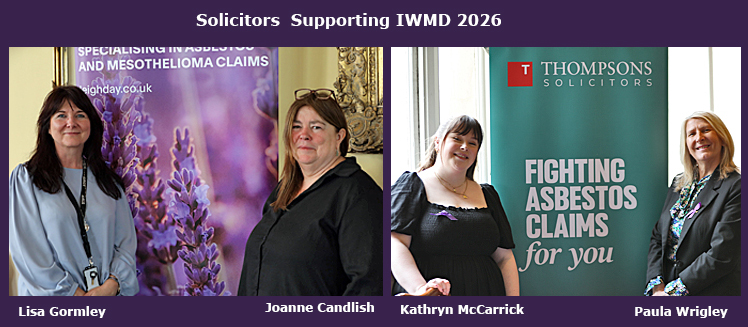
Lisa Gormley is a Senior Associate at Leigh Day, working with Joanne Candlish in the personal injury department specialising solely in asbestos disease cases. She has over 30 years experience as an industrial disease lawyer and over 15 years representing clients in asbestos compensation claims.
She joined Leigh Day in September 2025 having previously worked in another law firm, representing personal injury victims only.
Lisa holds a degree in Law and qualified as a Fellow with the Chartered Institute of Legal Executives in August 2002, and has held the status of an APIL accredited Senior Litigator and Asbestos and Occupational Disease Specialist.
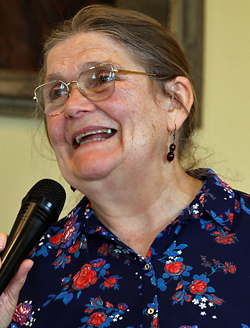
The guset speakers were Felicity Dowling from the Save Liverpool Women's Hospital, and Professor David Whyte from Liverpool John Moore's University were he is Professor of Climate Justice.
Felicity Dowling, Save Liverpool Women's Hospital Campaign was the first to speak:
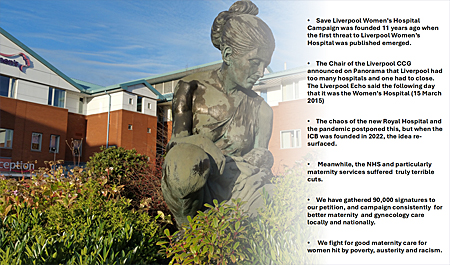
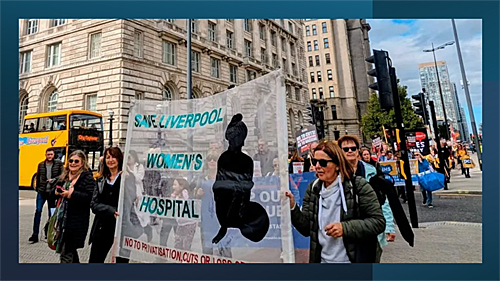
"I'm speaking from the Save Liverpool Women's Hospital campaign. And the campaign was founded nearly 11 years ago when they first set out to try and close the women's. And yes, we're actually still here, which means to some extent we've been successful.
But the things that happened in the meantime that stopped them going ahead with their plans. First of all, the chaos in rebuilding the new Royal was a major problem for them. And we know the building of the actual physical building in the new Royal is still a problem, let alone the staffing and the shortage of beds.
 Then obviously we have COVID as well. When the ICB was founded, which is in 2022, one of the first items on their agenda was the women's. The women's has not got enough money full stop. They cannot possibly balance their books because the maternity tariff, the amount of money that the government pays for maternity is inadequate.
It's sent a mass through across the country but this is the biggest maternity hospital in the country, probably the biggest in Europe and it will constantly be in financial trouble until the government changes the way it funds maternity and the NHS.
So we've gathered 90,000 signatures. And we're pleased that we've got 90,000 signatures. Half of them are online, but half of them are person-to-person conversations in Bold Street, in all the different places we go to campaigning. They tried to diss our petition, saying, "We don't know what you said to people to get them to sign that petition." At the engagement meetings that were held last year,
about their plans.
We know that that 90,000 signatures is a figure, but we'd love it to be 100,000, please folks, if you can get some more. Say Liverpool Women's Hospital on 38 Degrees is the online version of it. And 38 Degrees don't believe that we've got, you know, they keep phoning me up saying, "This petition's amazing."
Right, so we don't only fight for our hospital, we're part of the fight across the country for proper maternity care in this country for all women. But particularly our fight is for those women hit by poverty, austerity and racism because the outcomes for our people are twice as bad as the outcomes for the wealthy.
 The poorer the woman the more chance there is of losing the baby losing the mother or having a long-term injury and that's an insult to the labour movement we've got to organise the movement around those issues."
Felicity continued by detailing some of the horendous experiences women have had whilst giving birth, and of the camaigns to safeguard women and improve the birthing conditions they face:
"In summer 2026, we're expecting there to be formal consultation with the public about their plans for the women's. Their current plans are based on the idea of putting us on floor 9 of the Royal.
If you, like me, have been corridor treated at the Royal, you'd want to know why the hell floor 9 isn't used now. But what it is, it is where the offices are. And it's not just bureaucracy, it's where the doctors' offices are, it's where, and it is not adequate. And they admit it. that the rooms will not meet national standards for maternity care. They're too small. You think about the woman's giving birth and something goes wrong, someone presses the panic button and everyone rushes in. There has to be room for those machines to come in. But they're talking about floor 9 of the Royal instead of Crown Street in inadequate buildings.
I'm not going to talk about the state of the NHS locally, but believe you me, it's bad. And one of the most stupid things that's happening in the Royal is that they are not cleaning the non-clinical areas. So the doctors actually have to go and get a hoover themselves to clean their own offices. A doctor? having to clean their own office. It's madness, it's a mad waste of money. But that's how severe the cuts are in the NHS and obviously not filling vacancies is even worse.
So the ICB meets on the 28th of May 2026 and we think it'll be in Liverpool and we think they will publish their formal business plan for what they're going to do to the women's.
We need people to help by attending those consultation meetings. We need you to be raising awareness in the public about what's coming so it isn't a shock to everyone that people have missed the meetings. And we need to get the message around the doors and into the workplaces. I emphasise that, and into the workplaces."
 "The statistics for how many women died giving birth and how many babies died went down dramatically once the NHS was established. It was an amazing difference. My grandmother, just to go show how short the generations are, my grandmother had 13 babies of which 9 survived. And every one of those deaths hurt her as much as any woman's baby dying today.
They organised and they fought and Liverpool was at the heart of it. Liverpool was at the heart of founding the NHS in the sense that the socialist doctors first organised here, the working class women's organisations for birth control and the baby clinics started here.
One of my mother's aunties was thrown out of the house because she came to the house and told them they didn't have to keep on having babies. But they were a good Catholic family and they thought that was appalling. But good for the old auntie who set up the contraception clinic."
She added, detailing the appalling ICB proposals for women to give birith at the Royal Hopsital:
"Women at this point are suffering such a level of violence and general attacks that to have a women's place is massively important. And I wish we had Stephanie here, our ex-midwife, she goes mad at the idea of someone turning up at the Royal in labour, about to give birth and being told to get in the lift up to floor nine.
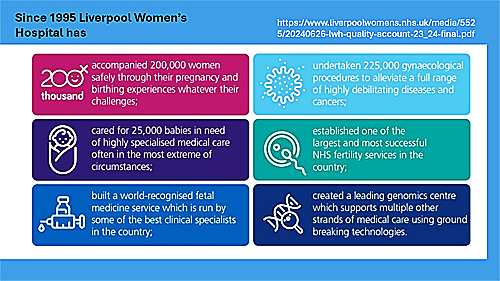
 It's a horrible suggestion. Anyhow, each year Liverpool Women's Hospital sees nearly 30,000 gynaecology procedures, at the same time welcoming around 7,500 new babies into the world. Nearly 1,800 staff support the hospital services that are delivered at Crown Street, including doctors, nurses and midwives."
That's directly from them. This is another one that is directly from them. 200,000 women helped to give birth. 25,000 babies needing highly specialized medical care and the neonatal unit at the women's is something to behold and they are trying there and they're working with six other hospitals who've got the best outcomes for neonatal care they're trying there to really make sure that babies born too soon not only live but thrive and the idea of risking that is an insult to the city. It's an insult to working people. So it's also the leading genomics, genetics, and it's the main fertility treatment centre for the North West. "
Commeting on the unsuitability of other hospitals to take on the work of the Liverpool Women's Hospital, Felciity said:
" Corridor care at the Royal is appalling, but if they're not unique, Aintree's appalling. All the main hospitals in Cheshire and Merseyside have terrible problems with corridor care. And West Street is saying that the winter crises will go on until the next election. And people, literally, it costs people's lives.
There's a long and deserved tradition of trusting the NHS in maternity and we don't want that to go but it is dripping away now. The outcomes for women giving birth now are worse than 20 years ago. Every other country on the planet except for the USA and Britain has seen a major improvement in maternal outcomes.
One of the big issues that women raise with us is the issue of birth trauma. How bad an experience they had giving birth. And that is getting worse and it's because the midwives don't have enough time. They're dealing with more than one woman giving birth.
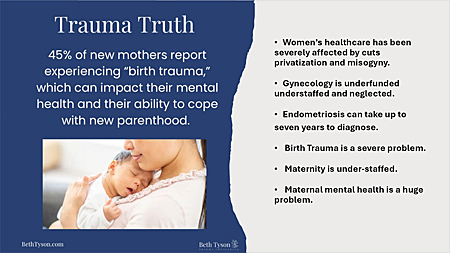 There's appalling situations where women are just simply not listened to. And that causes physical and mental health issues. And the biggest cause of death for women in the year after giving birth is suicide. And that comes largely from the trauma of giving birth.
Felicity then gave a harrowing example:
"I had a friend whose daughter had a horrific birth ending up with the dumping incontinence psychologically in full psychosis
and she was sent to and quite rightly sent to one of the baby units the NHS have in its mental health capacity but they couldn't deal with the fact she was incontinent so guess who looked after the psychotic woman and the baby and the double incontinent mum it was, it was a crazy crazy situation!
Baroness Amos was charged by Wes Streeting, the Health Secretary, to do an inquiry into the state of maternity. She isn't an expert in maternity. There have been 22 other major inquiries, including ones by Donna Ockenden, who is an expert in maternity.
The single simplest thing the government can do to improve things is to give us more midwives. But the midwives who qualified this year, this bit really, really gets me, are not getting jobs. Something like a third of the women who are qualifying this year are not getting a job as a midwife.
They've got the £50,000 debt, but they're not going to get the job as a midwife. And we need more midwives, we need more midwives, we need more midwives, we need more midwives. And the midwives need time to think, they need time to walk, they need time to discuss."
Referring to a slide of a retired midwife, she said:
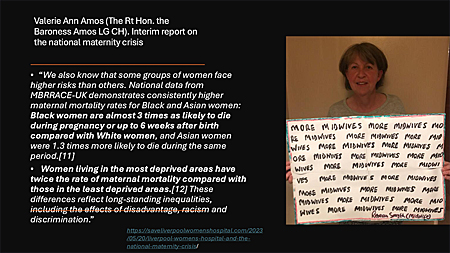 "Rebecca, who's holding that sign, is a midwife educator who's just retired.
She says when she was working as a midwife, 20 years experience. If she's having a difficult time with one delivery, she'd call in a couple of friends, couple of other midwives. Each of them had about 20 years experience. 60 years experience standing there talking about how to save that particular baby. Now, the lifespan, the working lifespan of midwives before they leave is much, much shorter. And we know midwives who've walked out at the end of the shift because the pressure is just too bad.
In one conference I was doing a stall act, someone came up and said, my daughter phoned me last night and said, she's a young midwife just qualified, I said, mum I'm in charge of 13 women, what the hell am I supposed to do? There's supposed to be a thing called birth rate plus, which regulates how many midwives there are when women are giving birth. We say that is inadequate. The hospitals say we're meeting birth rate plus, we're saying birth rate plus is not enough.
Liverpool Women's Hospital does need some improvements. It needs more staff to start with. The Care Quality Commission say it's a good hospital. They've got a good rating at a time when two thirds of maternity units did not. Two thirds of maternity units requires improvement. Cheshire and Merseyside is ruled by the Integrated Care Board as far as the NHS is concerned.
So, what we're saying, what we're asking for is that they keep gynaecology, maternity, the NICU, the genetics and the research and all the existing services at Liverpool Women's on Crown Street. And they invest there.
They've just done an inquiry on... They've just done a women's health strategy and a men's health strategy. The men's health strategy gets a budget, dates and resources. The women's health strategy gets aspirations.
We need a dedicated ambulance service, one where they're not dialing 999, but a dedicated ambulance service for transfers between all of the Liverpool hospitals. It's a mile down the road from the Royal and yet they'll tell you at the consultation meetings it's an isolated site sounds like it's in the middle of the moors or something. It's a mile!
 The number of women that are transferred will be the same whatever, there'll be women having to be transferred if there is in the Royal they'll be having to be transferred to other hospitals at times it's just the women's does not have enough people desperately ill to have the full scale intensive care unit and it doesn't.
We want to make sure that the situation for women is improved across the area and the fact that they didn't used to have enough staff at the women's for deteriorating staff was a scandal but an easily solved one, you employ more staff.
And then you have the situation where they are now outsourcing and insourcing operations. So if you go to the women's, you're not certain you can get women's level treatment because of their financial problems and the need to bring in the private sector all the time that this government is intent upon. And they're not hiding the fact they're intent on bringing more privatisation into the NHS.
We need them to hear no, no, no, no, no, long and loud. And then we need them to be saying, yes, we will find the money to fund maternity. And if you get any chance to get any kind of pressure on any of the MPs, please, please push that idea that above all, we need more midwives. We need more midwives.
Those young girls who try to be midwives, should not be sitting on the dole, they should be employed. And the young doctors that might want to go and train to be obstetricians should have training places, never mind West Street and strike breaking on the BMA strike and threatening not to have the training places for the NHS. So for women in Liverpool, for the babies in Liverpool, for the health of Liverpool, help us in this campaign, get involved. Thank you."
The next speaker was Professor David Whyte, Professor of Climate Justice:
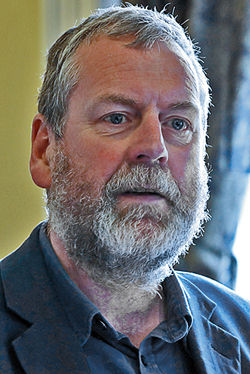 David opened his speech by saying:
"I just want to say thanks to John and everyone else who organized this because the turnout has been brilliant, the number of wreaths being laid, the number of unions represented. This is the kind of thing that we need to be doing year on year. And I think actually, you know, in my memory, this is one of the biggest. So, it's fantastic that John and colleagues are building momentum for this. So, I just wanted to start off by saying that."
Referring to our previous speaker, David commented:
"When I was listening to Felicity, I was thinking of a word that economists use that some of you might have come across. It doesn't matter; it's a technical word that economists use. Externalities. Externalities are basically costs. They can be benefits as well, but they're costs and benefits that don't show up on a standard basic cost balance sheet, on a standard corporate balance sheet. So, when we think about the costs, and when I think about the women's hospital actually on workers Memorial Day, I think about the gender aspects of ill health and death that women face at work.
Women and men face risks at work equally, but they face them in different ways. And I think, for example, about the number of cleaning workers that are exposed to chemicals that are made long-term ill, the majority of whom are women, or actually the link between breast cancer and shift work, which obviously affects women. We know there's a correlation there."
Professor David Whyte, continued his refence to the Save Liverpool Women's Campaign:
"And you need specialist services. You need specialist medical services to deal with all aspects of injury and ill health at work. And for ones that affect people in a gendered way, you need specialist services. So when I think about the women's hospital and what's happening to the women's hospital and what Felicity and Leslie and everyone else involved in that campaign have incredibly done over the years, I think about them actually defending aplace where employers literally get away with murder.
They get away with injuring and making people ill, and we pick up the costs. We pick up the costs through specialist services in the NHS, and now these are getting cut."
IWMD2026 Organising Committee member, Kenny Newton placed the IWMD Wreaths, as is custom after the Liverpool event, delivered them to the grave of Robert Tressel (Robert Noonan) in Liverpool Walton Cemetary.
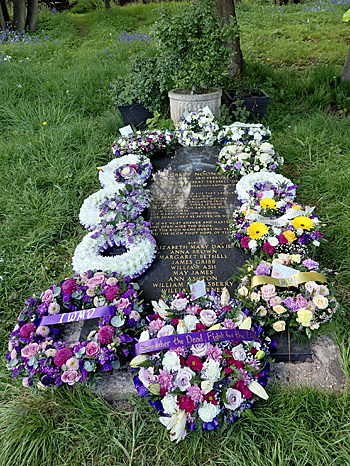
Photo: Kenny Newton
Reflections Of IWMD 2026 Liverpool
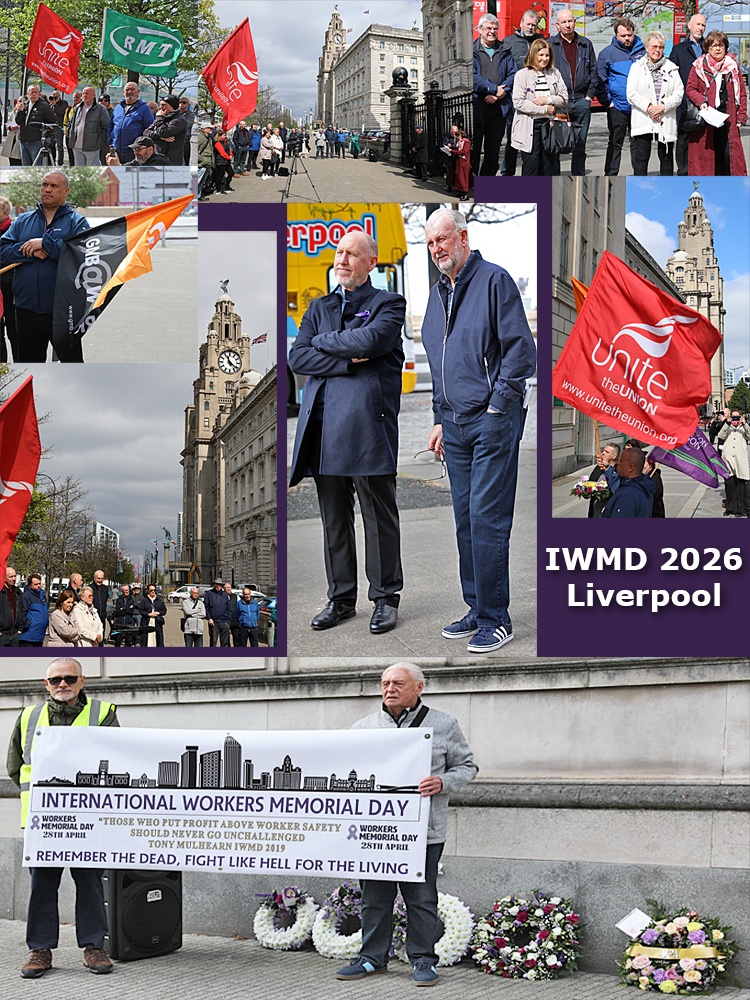
Source: Unionsafety / photo & video: Chris Ingram
